Follow-up appointment
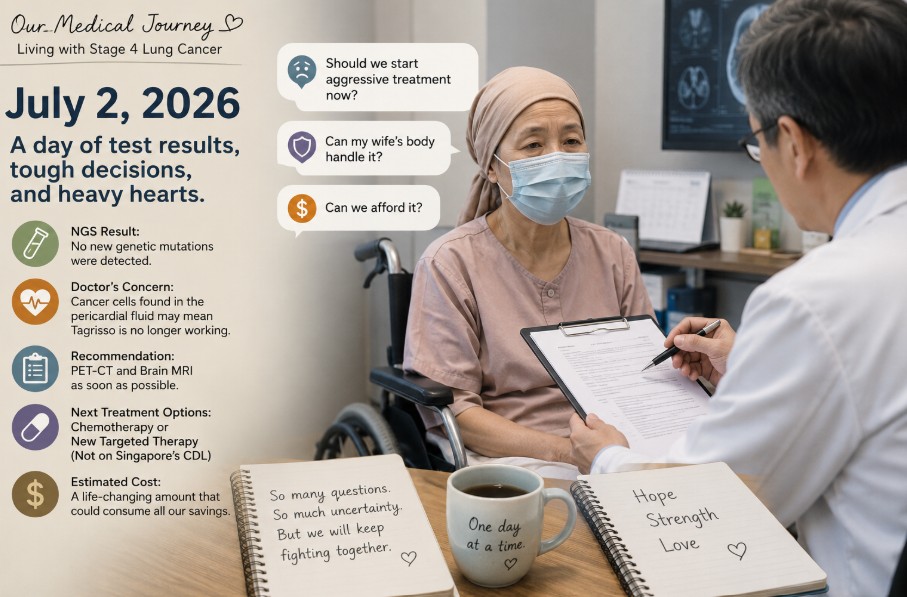
Today was our scheduled follow-up appointment with our oncologist. However, this visit felt much more important than our usual check-up because we were finally going to receive the results of the genetic analysis performed on the cancer cells found in my wife’s pericardial fluid during her recent surgery.
Since the surgery, her condition had changed dramatically. She was too weak to walk and had to use a wheelchair just to get into the clinic. Watching someone who had once been able to move around independently now struggle with even the shortest distance was heartbreaking.
After reviewing the report, our doctor said something that initially gave us a little hope.
“No additional genetic mutations were detected.”
To us, this sounded like good news. We understood it to mean that no new resistance mutations had been found and that the cancer cells still appeared genetically similar to those originally diagnosed.
However, the conversation quickly became more complicated.
Although the genetic test did not reveal any new mutations, our doctor explained that the presence of cancer cells in the pericardial fluid was, in his opinion, a strong clinical sign that Tagrisso might no longer be controlling the disease effectively. He believed that resistance could already be developing, even if current genetic testing was unable to identify the exact mechanism.
For that reason, he strongly recommended moving on to the next line of treatment. His recommendation was either chemotherapy or one of the newer targeted therapies. Before making a final decision, he insisted that my wife undergo both a PET-CT scan and a brain MRI as soon as possible.
I hesitated.
Looking at my wife sitting in the wheelchair, exhausted and barely able to keep her eyes open, I asked if we could postpone the scans until she regained a little more strength.
The doctor’s answer was immediate.
“No. We cannot delay.”
He went on to say that if she was too weak to come as an outpatient, she should be admitted to the hospital so the scans could be performed during her stay.
Before we left, we were also given an estimated cost for the recommended treatments.
That was another devastating moment.
The medications recommended for both chemotherapy and the newer targeted therapy were not included on Singapore’s Cancer Drug List (CDL). This meant that insurance support would be very limited, leaving us responsible for an enormous portion of the cost ourselves.
For the first time since this journey began, I realized that continuing treatment exactly as recommended could require us to spend virtually everything we had saved over a lifetime.
At the same time, another question weighed heavily on my mind.
Even if we somehow managed to pay for the treatment, would my wife, in her current condition, be physically strong enough to endure it?
She was barely eating, had lost a significant amount of weight, and could no longer walk without assistance. I wondered whether pursuing another aggressive treatment would give her more time—or simply more suffering.
On the way home, neither of us spoke very much.
My mind was filled with questions.
If no resistance mutation had been found, why were we already discussing changing treatments?
Was this really the right time to begin another aggressive therapy when she was struggling just to eat and walk?
Or should our first priority be helping her regain her strength?
That evening, I spent hours discussing these questions with ChatGPT.
One of the most important things I learned was that a negative genetic test does not always guarantee that a cancer remains fully sensitive to treatment. Cancer can sometimes become resistant through mechanisms that current genetic testing cannot detect. At the same time, treatment decisions should never rely on a single test alone. Imaging studies, physical condition, symptoms, and overall quality of life are all equally important.
Those conversations helped me understand the medical reasoning, but they did not make the decision any easier.
For us, the biggest concern was no longer simply fighting the cancer.
It was how to balance treatment, quality of life, physical suffering, and the enormous financial burden that came with every new option.
As we left the hospital that day, I realized that this journey was no longer only about choosing the next treatment.
It had become a much deeper question.
How do we make the most meaningful decisions for the time we still have together?
That was the question we carried home with us on July 2, 2026.
답글 남기기