When my wife finally returned home on June 27, I wanted to believe that the hardest part was over.
She had survived two major heart procedures, overcome severe vomiting caused by food poisoning, and was finally discharged from the hospital.
I thought home would be the beginning of recovery.
Instead, it became the beginning of a completely different life.
A Different Person Came Home
The woman who walked into our home was not the same woman who had left two weeks earlier.
Before the heart surgery, she could still move around the house by herself.
Now, even walking a short distance requires someone to support her.
Every step is slow.
Every movement takes effort.
Watching someone you love lose something as simple as the ability to walk independently is heartbreaking.
As a caregiver, there is nothing more painful than realizing you cannot restore what has been taken away.
New Symptoms We Never Expected
Cancer itself changes a person’s life.
But sometimes the treatments and surgeries change daily life just as much.
After returning home, another problem appeared.
If my wife could not reach the bathroom immediately, she would sometimes lose control of her bladder.
This was something completely new.
To avoid embarrassing situations, she now needs to wear protective diapers whenever we leave the house, and sometimes even while staying at home.
These are the realities that people rarely talk about when discussing cancer.
Medical reports describe tumors, blood tests, and scan results.
They rarely describe the emotional impact of losing independence.
Her Hearing Is Getting Worse
Another change has quietly entered our lives.
My wife often tells me she cannot hear clearly anymore.
Even when I speak normally, she asks me to come closer.
Sometimes I have to repeat the same sentence several times before she understands.
I honestly do not know whether this is related to aging, the cancer itself, the treatments she has received, or simply the physical exhaustion after months of fighting this disease.
It is another question we will need to ask her doctors during our next appointment.
Living with cancer often means living with uncertainty.
Sometimes you simply do not know which symptom belongs to which illness.
Eating Has Become One of the Hardest Battles
One positive change after leaving the hospital is that the constant nausea has become much better.
The severe vomiting that brought us back to the hospital has stopped.
For that, I am truly grateful.
But eating is still incredibly difficult.
Foods that are spicy…
Too sweet…
Or too salty…
Are almost impossible for her to tolerate.
Even the smell of certain foods sometimes makes her lose her appetite.
So every meal has become a careful balancing act.
I soften rice until it becomes almost like porridge.
She usually manages only one or two spoonfuls.
After that, I prepare about 100 ml of milk mixed with Beneprotein to increase her protein intake.
Later, I carefully cut a banana into tiny pieces.
One small piece.
Then another.
Sometimes just two tiny pieces become her entire snack.
To many people, this may not seem like a meal.
To us, every spoonful feels like progress.
Every Kilogram Matters
Before the surgery, my wife’s weight had reached around 57 kilograms, partly because of fluid retention before the heart surgery.
Today she remains around 47 kilograms.
Ten kilograms may simply look like a number on a scale.
For a cancer patient, it represents lost strength.
Lost muscle.
Lost energy.
Our goal now is no longer simply treating cancer.
It is helping her regain enough strength to continue treatment.
Nutrition has become just as important as medication.
Sleepless Nights
Nighttime has become another challenge.
Almost every evening she complains that her feet and calves ache.
Sometimes the discomfort keeps her awake for hours.
As caregivers, we are constantly looking for small ways to make life a little easier.
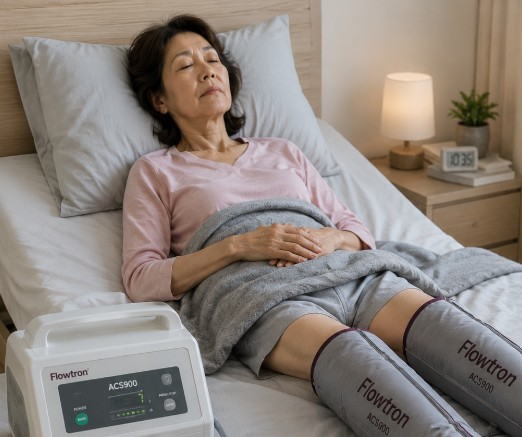
Today I decided to search for a medical device called the Flowtron ASC900.
She used one while staying in the hospital.
It gently inflated air chambers around her calves, creating a massage-like compression.
Watching her relax during those sessions gave me hope that perhaps we could recreate a little of that comfort at home.
Sometimes recovery is not about dramatic medical breakthroughs.
Sometimes it is simply about helping someone sleep through the night.
Accepting Our New Reality
I have finally realized something.
Life after surgery is not a return to the old life.
It is the beginning of a new one.
Our daily routine now looks completely different.
Meals are carefully planned.
Walking requires assistance.
Medication schedules fill our calendar.
Every small symptom is carefully observed.
Every good day feels precious.
Every difficult day reminds us how fragile life can be.
Looking Toward Our Next Hospital Visit
Next week we will return to the hospital for another follow-up appointment.
There are still many unanswered questions.
We are waiting for the genetic mutation analysis.
We are waiting for the resistance test results.
We are waiting to hear whether Tagrisso is still working or whether another treatment will be needed.
The uncertainty is exhausting.
But worrying about tomorrow does not change today.
So for now, we continue doing the only thing we know how to do.
One meal.
One short walk.
One conversation.
One hopeful day at a time.
A Message to Other Caregivers
If you are caring for someone with cancer, remember that recovery is not always measured by scan results.
Sometimes recovery is measured by one extra spoonful of food.
A few more steps across the living room.
A peaceful night’s sleep.
Or simply hearing your loved one say,
“I’m feeling a little better today.”
Those moments may seem small to others.
To a caregiver, they are everything.
Because when you love someone who is fighting cancer, hope is no longer found in giant victories.
Hope lives quietly inside the smallest improvements.
And sometimes…
those small improvements are enough to help you keep going another day.
답글 남기기