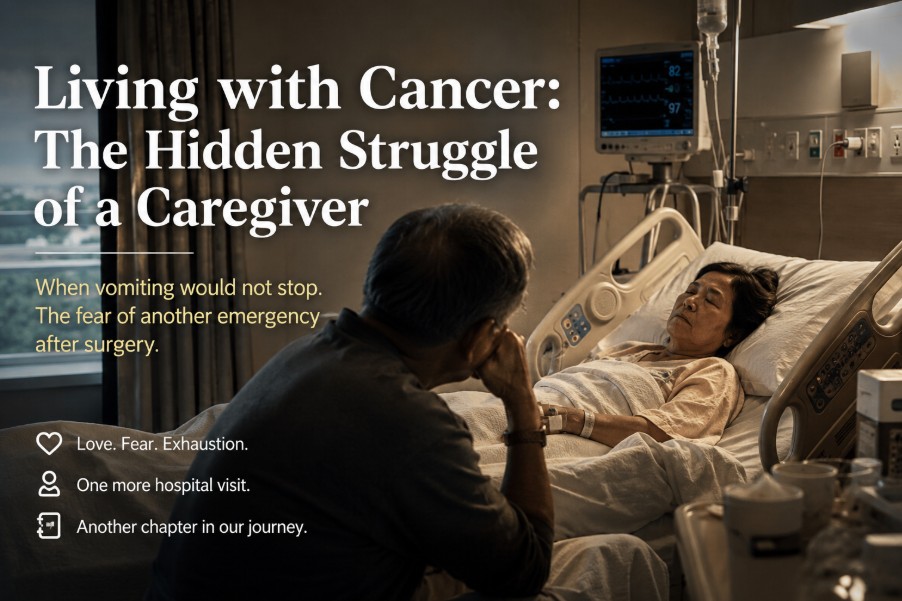
When Vomiting Would Not Stop: The Fear of Another Emergency After Surgery
After my wife returned home following her pericardial window surgery, we thought the hardest moment had passed.
Only two weeks earlier, she had been admitted to the hospital because a large amount of fluid had accumulated around her heart. Approximately 800ml of fluid was removed, and several days later she underwent surgery to create a pericardial window to prevent the fluid from building up again.
After spending about a week in the hospital, she finally came home.
But recovery was much harder than we expected.
She was physically weak, struggled to walk without help, and her appetite almost disappeared. Most meals became a challenge. Instead of normal food, she survived mainly on small amounts of soy milk, protein supplements, and occasionally a little banana or porridge.
We were trying to adjust to our new life after surgery.
Then, suddenly, everything changed again.
A Night of Continuous Vomiting
It started late at night.
My wife suddenly began vomiting repeatedly.
At first, we thought it might be a temporary stomach problem. She had experienced many medications, anesthesia, surgery, and physical stress recently. We hoped it would pass.
But it did not.
The vomiting continued throughout the night.
She could barely sleep. Her stomach hurt, and every attempt to eat or drink became difficult.
The next morning, I prepared a simple rice porridge because she said she wanted to try eating something.
She managed only two small spoonfuls.
A few moments later, she vomited again.
At that moment, my biggest concern was:
“Could this be intestinal obstruction?”
As a cancer patient who recently underwent surgery, I knew that any sudden change could not be ignored.
The Difficult Decision: Wait or Go to the Hospital?
I tried to contact her doctor, but unfortunately, the doctor was on leave.
The original plan was to somehow manage until Monday when the doctor would return.
But watching my wife continue vomiting, unable to eat, and suffering from abdominal pain, I realized that waiting might not be the right choice.
I faced a difficult decision.
Should I call an ambulance?
In Singapore, calling an ambulance usually means being taken to the nearest available hospital. Of course, emergency care is important, but I worried about the process:
New hospital.
New doctors.
Explaining her entire cancer history again.
Repeating tests.
Possible scans.
And after all of that, perhaps transferring back to her original hospital.
My wife was already exhausted. I did not want her to go through another stressful process if we could avoid it.
After thinking carefully, I decided to drive her directly to Raffles Hospital, where she had received her previous treatment.
Back to the Hospital Again
When we arrived, I explained everything:
- Her recent pericardial window surgery
- The removal of fluid around the heart
- Her poor appetite after discharge
- The sudden vomiting overnight
- The abdominal pain
- Her inability to keep food down
The medical team responded quickly.
They performed:
- Chest X-ray
- Abdominal X-ray
- ECG check
After evaluation, she was admitted to the hospital again.
Now she is in room 1019.
The vomiting has not completely stopped yet, and her stomach pain has become severe enough that she required pain medication through injection.
At this moment, she is finally trying to sleep.
Questions That Remain in My Mind
As a husband and caregiver, there is one question I cannot stop thinking about.
If this was possibly related to intestinal obstruction or another serious complication after surgery, why were we not given clearer guidance before discharge?
Of course, doctors cannot predict every possible complication.
But for families caring for cancer patients at home, simple information can make a huge difference:
- What symptoms should we watch for?
- When should we call the hospital?
- When is waiting dangerous?
- What signs require emergency attention?
After returning home, we often feel alone with these decisions.
As caregivers, we are not doctors.
We are simply family members trying to protect someone we love.
Another Chapter Begins
This journey with cancer has taught me something important.
The treatment itself is only one part of the battle.
After the hospital doors close and the patient returns home, another battle begins:
Managing symptoms.
Making decisions.
Watching every small change.
Trying to understand what is normal recovery and what is a warning sign.
Tomorrow, we will know more.
I will continue to record this journey—not only for myself, but hopefully for other families who may one day face a similar situation.
Because sometimes, the hardest moments of cancer are not inside the hospital.
They happen quietly at home, when a caregiver is standing beside the person they love, wondering:
“Am I making the right decision?”
답글 남기기