By the third day of hospitalization, we felt relieved that the initial drainage procedure had gone well.
Approximately 600 milliliters of fluid had been removed from around my wife’s heart, and the doctors were closely monitoring her condition.
The daily chest X-rays, bedside ultrasound examinations, and regular visits from the medical team suggested that she was stable.
In fact, one of the cardiologists described the most recent echocardiogram as “very good.”
For a brief moment, it felt as though the most difficult part might already be behind us.
However, the doctors soon explained that there was another important decision to make.
Looking Beyond the Immediate Problem
The drainage procedure had successfully removed the fluid that had accumulated around the heart.
But the medical team was concerned about what might happen in the future.
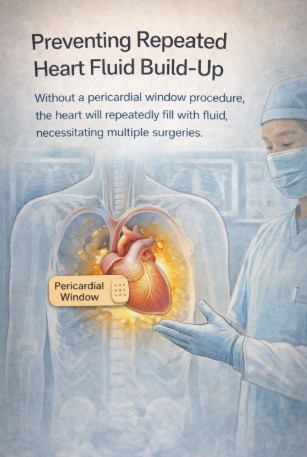
They explained that if fluid continued to build up, we could find ourselves facing the same problem again.
Each recurrence could potentially require another drainage procedure.
Rather than repeatedly removing fluid every time it returned, the doctors recommended a more durable solution.
That solution was a pericardial window procedure.
Understanding the Recommendation
The doctors explained that a pericardial window involves creating a small opening in the membrane surrounding the heart.
The purpose is to allow fluid to drain more freely instead of becoming trapped around the heart and causing pressure to build up again.
When they described it this way, the recommendation seemed logical.
The goal was not simply to treat the fluid that had already accumulated.
The goal was to reduce the chances of facing the same situation repeatedly in the future.
Although no family wants to hear that another procedure is necessary, we understood the reasoning behind the recommendation.
A Coordinated Approach
Throughout the hospitalization, several specialists were involved in my wife’s care.
The cardiology team focused on managing the condition around the heart and monitoring her recovery after drainage.
At the same time, the oncology team was evaluating the cancer cells that had been identified in the pericardial fluid.
Additional laboratory testing had already been planned, including advanced genomic and molecular profiling.
These tests were expected to take four to six weeks before results became available.
The findings would help determine whether the cancer had developed new genetic mutations and whether future treatment adjustments might be needed.
For now, however, the immediate priority was preventing another dangerous fluid build-up around the heart.
Preparing for Another Procedure
On June 10, the doctors informed us that the pericardial window procedure had been scheduled for Friday evening.
Although we were encouraged by her improving condition, we also understood that the medical team was trying to think ahead.
Their concern was not only about the present situation but also about reducing the risk of future complications.
As caregivers and family members, we often focus on today’s problems.
The doctors were looking several steps ahead.
Looking back, that conversation helped us understand why another procedure was being recommended even after the initial drainage had been successful.
In the next article, I will share our experience on the day of the pericardial window surgery, including the hours before the operation and what happened afterward in the intensive care unit.
댓글 남기기